Samaria
Acts of the ApostlesSamaria is a region and a narrative threshold in Luke-Acts: positioned between the largely Jewish settings of Jerusalem and Judea and the “ends of the earth,” it becomes the first major step in the widening reach of the church’s witness. The movement into Samaritan territory makes geography carry theological force: a community that shares roots with Jewish people but has developed its own religious life receives the news of the Realm, and the circle of disciples expands across a consequential boundary.
Position in the Narrative
In Jesus’s commission in Acts 1:8, the sequence of Jerusalem, Judea, Samaria, and the ends of the earth outlines the geography of the book as well as its developing account of inclusion. The narrative proceeds through Jerusalem and Judea, then Samaria, and onward toward the wider world. Samaria is therefore not a detour from the central story. It occupies the passage between the symbolic heart of Judaism and the movement’s eventual reach among gentiles.
That geography also functions as a sign of the story’s larger direction. As the sequence announced by Jesus unfolds, the reader is invited to trust Luke’s account of the movement of history toward its consummation. The expanding route shows the nature of the Realm: its witness reaches first Jewish people, then Samaritans, and then gentiles. Samaria marks a change in the community’s reach without erasing the preceding Jewish setting from which the mission begins.
The region’s place in Luke-Acts belongs to a wider journey structure, from Galilee to Jerusalem and from Jerusalem through Judea and Samaria toward the ends of the earth. The account ultimately extends from Elizabeth within Judaism to Paul in Rome and the gentile mission. Read within this trajectory, Samaria is an in-between place whose narrative importance lies in movement across a boundary, not simply in its position on a map.
A Neighboring Religious Community
Samaritans worship the same God within a broad tradition shared with Jewish people, but developed a distinct culture and religious practices. Their canon centers on their own version of the Pentateuch, and their tradition places worship on Mount Gerizim. They had their own priesthood and observed Passover, Pentecost, and Booths. The book characterizes Samaritanism as closely related to Judaism—a first cousin, rather than an unrelated faith.
The relationship between Jewish and Samaritan communities should not be flattened into a story of permanent hostility. Tensions existed, but there were also periods of tolerance and cooperation. Luke’s account of disciples entering Samaritan territory and engaging with its residents fits the Gospel’s earlier positive depictions of Samaritans. The setting thus raises the question of how a community navigates real religious and cultural difference without treating its neighbors as a single, unchanging hostile group.
Samaria’s position as a borderland is both geographic and social. Samaritans share elements of Jewish belief and practice while maintaining distinctions that could prompt wariness. In the book’s account, the region lies at the edge of the Jewish world and the “ends of the earth.” That intermediate status makes the encounter there a test of whether the movement can cross a boundary without pretending that the difference has vanished.
The Mission in Samaria
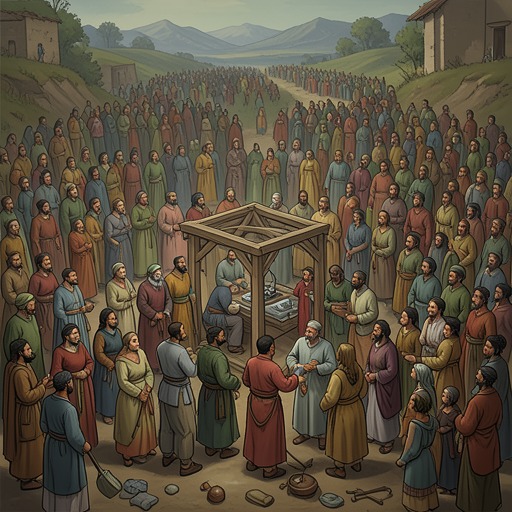
In Acts 8:4–25, the witness enters Samaritan territory after Jesus’s commission. Philip is the principal messenger: as one of the seven, his presence signals that the mission is authenticated by the church. Through him, God works signs, and his preaching explicitly announces the news of the Realm. The episode presents outreach not as an isolated initiative opposed by the church’s leadership, but as a mission joined by its authoritative representatives.
The welcome is broad. Samaritans receive the presence and coming of the Realm, and many respond positively to Philip’s preaching and are baptized. Among them is Simon, a widely known magician. In the ancient setting described by the book, magic meant attempts to affect the forces governing life through incantations, formulas, ceremonies, and other means; it was not the modern image of stage entertainment. Simon’s inclusion makes the reach of the Samaritan response especially visible: the new community includes people beyond the social and religious circles from which the movement had begun.
Peter and John travel from the apostolic circle to join Philip and the converts. Their arrival reinforces the church’s recognition of what is happening in Samaria. The episode therefore links local witness with wider communal authority: Philip carries the message, Samaritan hearers receive it, and apostles from Jerusalem participate in the developing mission. The movement’s institutional center, in this instance, supports rather than blocks an expansion across a cultural boundary.
The account also distinguishes water baptism from the reception of the Spirit. Peter and John lay hands on the newly baptized Samaritans, and the book treats baptism and the Spirit as experiences that can occur at separate times. This pattern does not settle every later disagreement about their timing; the underlying point is that both baptism and the Spirit belong to a fully empowered community. Samaria’s incorporation is thus narrated through both visible communal welcome and participation in the Spirit’s empowering work.
From Samaria Toward the Wider World
The Samaritan mission precedes the encounter between Philip and the Ethiopian eunuch on the wilderness road from Jerusalem to Gaza. That next episode carries the witness farther in geography, ethnicity, political power, and matters of gender. The sequence gives Samaria a hinge-like role: it is a substantial widening of the community’s reach, yet also a passage toward further crossings that the narrative presents as unexpected.
This progression makes Samaria a measure of inclusion rather than a final destination. The book’s account asks readers to consider who, in their own setting, resembles the Samaritans: people close enough in belief or practice to be recognizable, yet different enough to provoke caution. The question grows from the narrative’s concrete geography. A witness that moves through Samaria must engage people on the edge of its familiar world, not merely announce an abstract openness to outsiders.
Samaria consequently embodies the church’s movement from a largely Jewish beginning toward a community that includes Samaritans and gentiles. Its distinct religious identity remains part of the story, even as its residents welcome the Realm and join the baptized community. Luke-Acts makes the crossing itself significant: the mission advances not by bypassing the borderland, but by carrying its witness into it and allowing the community to grow there.